
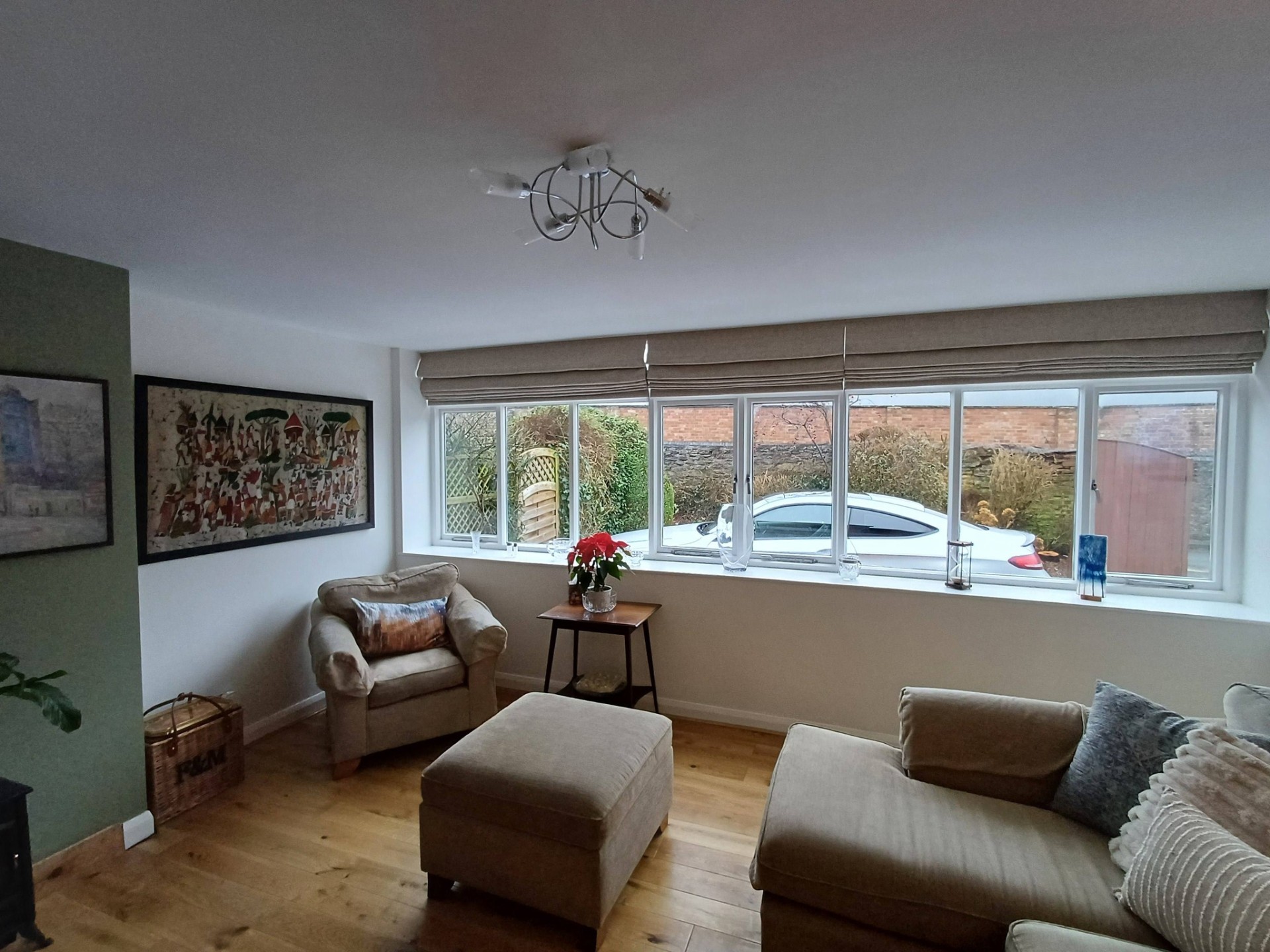
Made-To-Measure Roman BlindsHand-Sewn In Premium Lined FabricsAcross Ludlow, Hereford & Shrewsbury
The softness of a curtain with the precision of a blind, pleated to your exact drop, lined or blackout, surveyed in your home with the actual fabric in your actual daylight.
Premium designer fabrics in-house. Hand-sewn linings. Owner-fitted from survey to install.
What it is, who it's for, and why it matters
What it is
A Roman blind is a single fabric panel sewn with horizontal rod pockets so it folds into deep, soft horizontal pleats as it lifts. Operated by a chain or motor against a headrail. The fabric is the feature, Romans show the cloth, not the mechanism.
Who it's for
Owners who want softness and texture but find full curtains too heavy for the window or the room. Common in living rooms, bedrooms, dining rooms, and any home with statement architecture where the window is part of the focal scheme.
When to specify it
Specify a Roman when the window is the focal point, when the room calls for a fabric texture, or when you want the option of a designer-house pattern (Sanderson, Romo, Designers Guild, Linwood, Voyage).
Why professional matters
Roman blinds are sewing-table-built, quality is entirely a function of who stitches the linings, sets the rod spacing, and balances the fabric weight against the cord tension. A 5cm sag in the bottom rail tells you the maker skipped a stage.
Get the spec wrong and it costs you more than the original install
Roman blinds go wrong in ways that are obvious from across the room.
Real risks if ignored
- Cheap blinds use stitched-on rod pockets that pucker the fabric within months.
- Wrong rod spacing makes the bottom pleat hang twice as deep as the others, the eye notices immediately.
- Unlined fabric fades unevenly down the cord routes within one summer.
- Fabric printed off-grain (warp not square to weft) means the bottom rail droops on one side.
Common spec mistakes
- Ordering without a fabric test, many designer prints look completely different in north-facing daylight than under shop lighting.
- Skipping the blackout lining on a bedroom, light bleeds through pattern even with a 'thermal' lining.
- Choosing patterned fabric without considering the pleat, a strong horizontal pattern is bisected by every fold.
- Specifying a single wide blind over a wide window, pleats sag in the middle.
We bring 1000+ designer samples to every Roman survey, test the fabric against the actual daylight in your room, and balance the rod spacing against the fabric weight so the pleats stack evenly from day one.
Five stages, one person, no handovers
- 01
Fabric Library Visit
We bring large fabric samples, not postcard squares, from Sanderson, Romo, Designers Guild, Linwood, Voyage, Prestigious, Clarke & Clarke and more. You see them against your wall and in your light.
- 02
Lining Decision
Standard cotton lining, thermal lining (winter warmth + summer cooling), blackout lining, or interlined (interlining gives a curtain-like softness to the pleats).
- 03
Hand Manufacture
Sewn by UK workrooms with calibrated rod-spacing rigs. Lead time 3–5 weeks for in-house fabrics, 5–7 weeks for designer-house specials.
- 04
Install
Single-visit fit. We mount the headrail, dress the pleats by hand so the folds memorise, and test the lift to full height before sign-off.
- 05
Aftercare
10-year written installation guarantee. Removable cassettes mean dry-cleaning is straightforward, we provide written care instructions.
Specific outcomes, not vague promises
Soft, Tailored Look
Deep pleats give the window a tailored, finished feel without the bulk of curtains.
Designer Fabric Choice
Access to every major UK fabric house, match an existing sofa, cushion or wallpaper with confidence.
Lined For Performance
Thermal and blackout linings turn a soft fabric into a high-performance window covering.
Frees The Window Sill
Unlike floor curtains, a Roman stops at the sill, keeping radiators clear and sill furniture usable.
Child-Safe
Cordless lift, motorised, or tensioned chain, all blinds ship to BS EN 13120 compliance.
Long Life
A properly-made Roman in heavy designer fabric is good for 15+ years before the fabric tires.
Materials, methods and variations
Everything we'd cover with you on a 45-minute survey, written down so you can read it in your own time before booking.
Linings Explained
Standard cotton lining adds opacity and protects the face fabric from UV. Thermal lining adds an acrylic backing that reflects radiant heat, useful on single glazing. Blackout lining adds a three-pass coating that blocks 100% of light through the cloth (side gaps still need a return). Interlining adds a soft cotton-wool layer between face and lining for a heavyweight, curtain-like fold.
Pleat Styles
Standard cascade (each fold sits above the next when raised, most common). Hobbled / waterfall (the fabric stays pleated even when fully down, for a permanently soft look). Front-fold (the rod pockets are hidden behind a face flap, for the cleanest fabric face).
Headrail & Control
Standard chain with safety device. Cordless spring. Motorised, battery or wired. Wide blinds (over 1.6m) can be fitted on a continuous headrail with twin operating cords for even lift.
Fabric Choice Guide
Linen and linen-blends for the textured, soft look. Heavy cotton for tailored window-treatment fabrics. Velvet for statement living rooms. Patterned designer prints for feature windows. Performance fabrics (FR, antimicrobial) for kitchens, clinics and HMOs.
Bay & Wide-Window Specification
Bay windows: one Roman per pane, all on the same drop, all in the same pattern repeat, all chain-aligned to a single side. Wide single windows over 2.4m: split into a coupled pair on a single headrail with synchronised lift.
Residential vs Commercial
Commercial Romans for restaurants and hotels are made in FR-treated fabric to BS 5867 Part 2 Type B, with reinforced sewing, and re-tested annually. We hold the relevant certification on file.
Honest answers, the ones we give on the doorstep
How much do Roman blinds cost?
From approximately £220 per window fitted in our in-house fabric range with thermal lining. Designer-house fabrics (Sanderson, Romo, Designers Guild) priced higher depending on the pattern repeat and lining.
Can I provide my own fabric?
Yes, provided it is upholstery-grade and meets fire regulations for blind use. We add a 'making' charge to cover the lining, rod pockets, headrail and fitting.
Will the bottom rail hang straight?
Yes, that is exactly what hand-sewing buys you. We use calibrated rod spacing and balance the bottom weight to the fabric weight before despatch.
Are they good for blackout?
Yes, with blackout lining, but specify side returns or U-channels for total nursery-grade blackout. Without them, light still escapes around the edges.
Can I clean them?
Yes, Romans are designed to be removed from the headrail and dry-cleaned. We supply written care instructions specific to your chosen fabric.
Will they fade in sunlight?
All fabrics fade eventually, but standard lining adds 3–5× UV protection to the face fabric. South-facing rooms: we recommend a UV-rated fabric and a lined back as standard.
What about pattern matching across multiple blinds?
We order with pattern match between blinds at your specification, useful in bays and across single walls of windows. Mention it at survey.
How long do they take?
3–5 weeks for in-house fabric. 5–7 weeks for designer-house special-order fabric.
Designer Roman blinds, hand-sewn for your home
Free in-home survey with our fabric library. Written quote in 24–48 hours. No obligation.
- 10-year written installation guarantee
- 5★ Google-rated surveys
- Same-week surveys
- Fully insured, owner-fitted
Request your free home survey
Most surveys booked within 5 working days.